For more than a decade, the Queensland Water Regional Alliances Program (QWRAP) has stood at the forefront of collaborative water reform in regional and remote Queensland. What began as an industry led alternative to top down structural reform has grown into a mature, statewide program that strengthens the capability, resilience and sustainability of water and sewerage services across nine diverse regions.
As we enter 2026, QWRAP continues to evolve, shaping a future where councils work together to overcome shared challenges, lift performance, and deliver safe, secure and reliable services for their communities, underpinned by funding from the State Government.
A Brief History of QWRAP
QWRAP’s origins trace back to a period of significant sector upheaval. Between 2007 and 2013, the Queensland water sector experienced rapid demographic shifts, skills shortages, governance changes and restructuring pressures. In response, the Queensland Water Directorate (qldwater), and the Local Government Association of Queensland (LGAQ) collaborated with councils to explore council‑driven reform and regional collaboration models.
Three major national reviews in 2011 from Infrastructure Australia, the National Water Commission and the Productivity Commission, concluded that improved regional collaboration and aggregation models were needed in Queensland and NSW.
Rather than pursue forced amalgamations, LGAQ and qldwater jointly proposed a voluntary, industry‑led approach. With support from the Queensland Government, the Queensland Water Regional Alliances Program officially commenced in late 2011.
The Remote Area Planning and Development Board (RAPAD) Outback Regional Water Alliance and Far North Queensland Region of Councils (FNQROC) became early adopters of the model, demonstrating the benefits of coordinated planning, joint procurement, and shared technical expertise.
Today, QWRAP is a partnership between the Queensland Government, the Queensland Water Directorate (qldwater), the Local Government Association of Queensland (LGAQ) and almost 60 participating councils, supported by $2 million in annual state funding.
QWRAP in 2026: A year of strengthened capability and regional impact
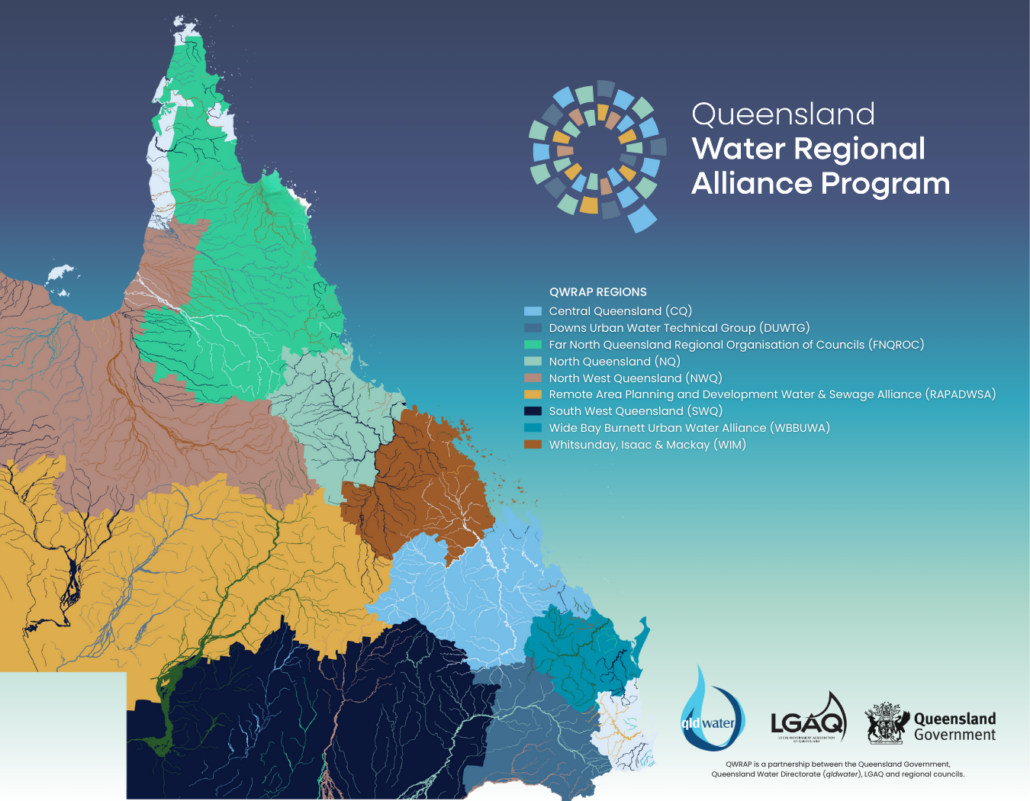
With nine active QWRAP regions now operating across the state, 2026 is shaping up to be a year defined by investment in capability, smarter systems, and coordinated regional action.
Across the latest Bid Pool projects (September–December 2025), all regions have positioned themselves for strong progress in 2026. Key themes emerging from this work include:
Asset management – strengthening foundations for the future
Several regions have initiated or advanced major asset management initiatives that will continue into 2026, including:
- The North Queensland QWRAP Asset Management Assessment and Infrastructure Upgrade Program (Phase 1) focused on building consistent regional approaches to condition assessment and renewal planning.
- The Central Queensland Water and Sewerage Technical Group collaborative Water Industry Asset Maintenance Standard and the combined asset, skills and financial sustainability project, providing region‑wide insights into long‑term risks and investment needs.
- The North West Queensland Regional Water Alliance Asbestos Cement (AC) mains and sewer pump station condition assessments, supporting future network upgrades in some of the state’s most remote communities.
These initiatives reflect QWRAP’s core purpose: enabling councils to share data, tools and expertise that would otherwise be difficult to resource individually.
Coordinated Drinking Water Quality Management Plan (DWQMP) audits – improving safety and consistency
Multiple regions, including the RAPAD Water and Sewerage Alliance, South West Queensland Water and Sewerage Alliance and North West Queensland Regional Water Alliance, are advancing or completing joint DWQMP audits and reviews, streamlining compliance workloads and ensuring alignment with best practice.
Pooling auditing services not only delivers cost efficiencies; it also promotes a shared understanding of risk and continuous improvement across councils facing similar challenges.
Desludging and network assessments – reducing risk and extending asset life
Several alliances are progressing important wastewater and lagoon‑based initiatives, such as:
- Lagoon desludging pre‑assessments in South West and North West Queensland.
- Sewer relining planning and joint procurement across the South West Queensland Water and Sewerage Alliance and the Downs Urban Water Technical Group.
- Smart sewer monitoring in the Whitsunday Isaac Mackay Water Alliance region.
These projects represent practical, collaborative steps that prolong asset life, reduce environmental risk and lower ongoing maintenance costs.
Joint procurement – smarter spending through shared investment
Joint procurement remains one of QWRAP’s strongest value drivers and continues to grow in 2026. Examples include:
- Chemical supply, sewer relining and manhole rehabilitation procurement coordinated by the Far North Queensland Water Alliance.
- Sewer relining and reservoir cleaning joint procurement under the Downs Urban Water Technical Group.
- Shared SCADA, audit, and training procurement initiatives in the Wide Bay Burnett Urban Water Alliance.
By purchasing together, councils secure better value, stronger contractual oversight, and consistent service quality.
Capacity building – investing in people and regional skills
QWRAP’s long‑term vision recognises that infrastructure is only as strong as the workforce that sustains it.
In 2026, several regions will advance capability‑building initiatives, including:
- Proposed Operator Forums (North Queensland).
- Exploration of ongoing collaborative training opportunities, enhancing learner experiences and outcomes.
- Graduate and early‑career support programs, highlighted in statewide success stories.
These investments reflect QWRAP’s commitment to fostering a resilient and future‑ready workforce across regional Queensland.
A collaborative future: QWRAP’s next chapter
Looking ahead, QWRAP’s role will remain pivotal in supporting councils as they navigate growing challenges including climate variability, ageing infrastructure, workforce shortages and rising compliance complexity.
Emerging focus areas for 2026 and beyond include:
- Digital transformation, including smart monitoring technologies and shared data platforms.
- Regional control centre concepts and coordinated network operations.
- Long‑term infrastructure planning for remote and low‑density communities.
- Strengthened regional governance and alliance capability.
As Queensland’s nine QWRAP regions continue to mature, the value of collaboration is clearer than ever: shared problems solved together lead to better outcomes for communities.
QWRAP’s story began as an industry‑led response to uncertainty. Today, it is one of the state’s most successful examples of voluntary regional collaboration driving efficiency, innovation and sustainability in the delivery of essential water services.
With a full pipeline of projects and a strong foundation of regional partnerships, 2026 promises to be a year of meaningful progress across Queensland’s water sector.
 Chairs & Coordinators Forum 2026August 20, 2026 - 10:00 am
 Coordinator Spotlight: Scott MasonJuly 24, 2026 - 4:00 pm
 Building a Regional Approach to Asset MaintenanceJuly 4, 2026 - 10:00 am
 Addressing Workforce Challenges in Queensland’s Water IndustryMay 30, 2024 - 3:31 am
 Smoothing out the Infrastructure CliffNovember 22, 2020 - 9:09 am
 Insights from the QWRAP-Minerva ReviewNovember 1, 2019 - 5:11 am
 HR/IR ToolkitApril 19, 2024 - 9:00 am


 Interflow